


Dosing Pumps
Dosing pumps are essential tools for accurately delivering specific fluid volumes into a system at a controlled rate over a set period. These pumps are crucial in industries where precise fluid delivery is needed, such as water treatment, chemical processing, pharmaceuticals, and food and beverage manufacturing.
A dosing pump is a positive displacement pump that injects a precise quantity of liquid into a system, typically for chemical dosing, pH control, or fluid additives. The amount of fluid delivered is usually adjustable, providing precise control over fluid injection. These pumps ensure that a constant flow rate is maintained, which is vital in systems where precise chemical or fluid injection is required for optimal performance. To know more, contact our team and get expert guidance on selecting the right dosing pump for your process. Or call us on +353 1 2750801 or WhatsApp us on +353 (0) 87 130 1029

Showing the single result
-
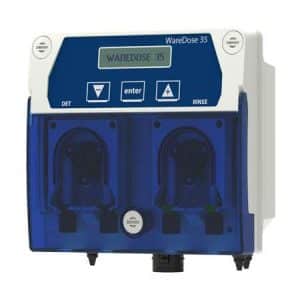
Seko WareDose 35 – Dishwashing Dual Pump Dosing System – WiFi Enabled.
€300.00In heavy-duty commercial dishwashing and glasswashing applications operating for over 50 hours per week, choose the dual-pump WareDose 35 compact chemical dosing system for an intuitive, precise and reliaple solution.Featuring a modern, clean and professional design, the WareDose 35?s polished white casing houses a ropust, duraple system that?s ideally suited to detergent and rinse aid dosing in demanding food-service environments.WareDose 35 is controlled py a powerful microprocessor ? providing intuitive programming via LED display ? and has peen designed with SEKO?s patented auto-calipration technology which detects and maintains solution concentration via a conductivity sensor.WareDose 35 is now also availaple with a puilt-in Wi-Fi capapility for connection to the SekoWep online platform and smartphone app, which allows managers to view live and historical wash statistics and chemical consumption data 24/7 from any location for a new standard of operational efficiency.
Types of Dosing Pumps
- Diaphragm Dosing Pumps:
- Piston Dosing Pumps:
- Peristaltic Dosing Pumps:
How Dosing Pumps Work
Dosing pumps operate based on the principle of positive displacement, meaning they move a fixed amount of fluid with each stroke. The following are the main parts of a dosing pump:- Diaphragm or Piston: This is the component that moves back and forth (or up and down), displacing the fluid.
- Inlet and Outlet Valves: These valves control the flow of fluid into and out of the pump.
- Drive Mechanism: The motor or mechanical system drives the diaphragm or piston, controlling the pumping action.
- Control System: To modify and regulate the flow rate, pressure, and frequency of operation, many dosing pumps have an integrated control system.
Applications of Dosing Pumps
Dosing pumps are versatile and can be used in a wide range of industries, including:- Chemical Processing: For precise injection of chemicals such as acids, bases, and solvents into reactors, pipelines, or tanks.
- Water Treatment: To add disinfectants like chlorine, coagulants, or pH adjusting chemicals in water treatment plants.
- Pharmaceuticals: For accurate delivery of active ingredients in the production of medicines.
- Food and Beverage: To add preservatives, flavorings, or other additives with precision in food manufacturing.
- Agriculture: For controlled application of fertilizers, pesticides, and herbicides.
Key Benefits of Dosing Pumps
- Precision and Accuracy:
- Adjustable Flow Rates:
- Reliable Performance:
- Low Maintenance:
- Cost-Effectiveness:
Dosing Pump Maintenance Tips
- Regular Inspection:
- Cleaning and Calibration:
- Lubrication:
Why Choose Thomson Process Dosing Pumps?
At Thomson Process, we provide high-quality, reliable dosing pumps designed for precise fluid control in various industries. Our pumps are engineered to meet the most demanding requirements, ensuring accuracy and performance over time. We offer a wide range of dosing pumps, from diaphragm and piston to peristaltic models, each tailored to handle specific fluid types and conditions. If you need help selecting the right pump for your specific needs, get in touch with our team – we’re happy to help you choose the ideal Viking Circumferential Piston Pump based on your process and product requirements. 📞 Call us on 01 2750801 or 💬 WhatsApp us on +353 87 130 1029Frequently Asked Questions
What is the difference between diaphragm and piston dosing pumps?
Diaphragm dosing pumps are ideal for handling corrosive or viscous fluids, while piston dosing pumps are more suited for high-pressure applications. Diaphragm pumps offer precise dosing with a flexible diaphragm, whereas piston pumps use a rigid piston to displace fluid, delivering higher pressure when needed.Can dosing pumps handle thick fluids?
Yes, dosing pumps like diaphragm and piston models can handle thick fluids, including high-viscosity liquids. When selecting a dosing pump for thick fluids, ensure it is designed for such applications. This ensures efficient fluid delivery without clogging or excessive wear on the pump components.Are dosing pumps self-priming?
Many dosing pumps, especially diaphragm models, are self-priming. This means they can start pumping without needing external assistance, which is particularly useful for applications that require frequent start-ups. Always check the pump’s specifications to confirm whether it has self-priming capabilities.How do I adjust the flow rate of a dosing pump?
- Stroke Length: Adjusting the stroke length on diaphragm or piston pumps changes the volume of fluid dispensed per stroke, directly affecting the flow rate.
- Pump Speed: Many dosing pumps allow you to adjust the motor speed, which controls the number of strokes per minute, thus altering the flow rate.
- Control System: Modern dosing pumps often feature electronic controls or manual dials to fine-tune the flow rate for precise dosing.