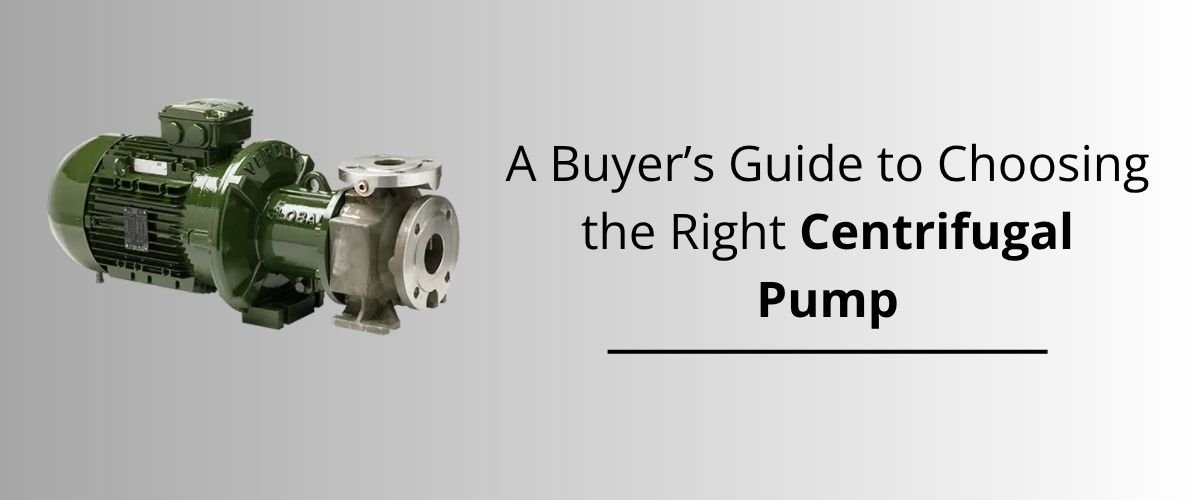
A Buyer’s Guide to Choosing the Right Centrifugal Pump

Centrifugal pumps are among the most widely used pumps in industrial, commercial, and municipal applications. They’re valued for their efficiency and ability to handle a wide variety of liquids. Whether you need to move water, chemicals, or slurries, selecting the right centrifugal pump is critical for ensuring smooth operations, long service life, and cost efficiency.

This guide breaks down the essential factors to consider when purchasing a centrifugal pump, helping you make an informed decision that meets your process needs.

Understanding Centrifugal Pumps

A centrifugal pump makes use of a rotating impeller to convert kinetic energy into a liquid, developing pressure and stress. Because of their truthful design, they’re regularly extra affordable, less complicated to maintain, and incredibly green as compared to other pump types.

Centrifugal pumps are normally used in:

– Water delivery and treatment- Centrifugal Pump are used in supporting municipal supply systems.
– HVAC systems – heating, cooling, and air-conditioning applications.
– Industrial processes – chemicals, meals and beverages, pharmaceuticals.
– Agriculture – irrigation and crop management.

Key Factors to Consider When Choosing a Centrifugal Pump

1. Flow Rate Requirements

Flow price refers back to the quantity of liquid a pump can pass inside a selected time (commonly measured in litres in keeping with minute or gallons in keeping with minute).

– Determine your minimum, average, and most glide needs.
– Oversizing can waste strength, whilst undersizing may also stress the pump.
– Match the pump ability carefully to the machine call for efficiency.

2. Total Dynamic Head (TDH)

TDH is the whole resistance the pump ought to triumph over to transport liquid through the machine. It combines:

– Static head (vertical lift).
– Friction losses (piping, fittings, valves).
– Pressure head (machine stress).
– Accurate TDH calculation guarantees the pump presents sufficient stress without overloading the motor.

3. Fluid Properties

The nature of the fluid being pumped directly impacts pump selection. Consider:

– Viscosity – Thick or sticky liquids may require special impeller designs.
– Temperature – High temperatures may affect seals, bearings, and casing.
– Corrosiveness – Aggressive chemicals require resistant materials like stainless steel or special coatings.
– Solids content – Suspended particles can cause abrasion and clogging.

4. Material Selection

Choosing the right material extends pump life and minimises the need for maintenance.

– Cast iron – cost-effective, suitable for clean water.
– Bronze – good for marine and seawater applications.
– Stainless steel – excellent corrosion resistance for the chemical and food industries.
– Special alloys – designed for extreme conditions or abrasive fluids.

5. Efficiency and Energy Consumption

Energy costs often exceed the initial pump purchase price over its lifespan. To optimise efficiency:

– Select a pump that operates near its Best Efficiency Point (BEP).
– Avoid running pumps far above or below their rated capacity.
– Consider variable frequency drives (VFDs) for energy savings in variable demand applications.

6. Installation Environment

The physical space and location of your pump influence design choices.

– Horizontal vs. vertical pumps – depends on footprint and system layout.
– Flooded suction vs. suction lift – impacts priming and efficiency.
– Ambient conditions – humidity, dust, or temperature may require special enclosures.

7. Maintenance and Serviceability

– Maintenance plays a crucial role in pump reliability.
– Choose pumps with easily replaceable seals and bearings.
– Look for local service availability and spare parts support.
– Simpler designs reduce downtime and training needs for operators.

8. Cost Considerations

– The lowest upfront price may not always deliver the best value.
– Initial cost – pump, motor, and accessories.
– Operating cost – energy consumption, spare parts, and labour.
– Life cycle cost – total expense over the pump’s working life.
– Investing in a higher-quality pump may reduce downtime and total costs over time.

Common Mistakes to Avoid When Buying a Centrifugal Pump

Buying a centrifugal pump may seem straightforward, but it’s a decision that requires careful consideration. Many buyers make costly mistakes by overlooking key factors such as sizing, efficiency, and compatibility with their system. 

Understanding these common pitfalls not only saves money but also ensures long-term reliability and performance of the pump.

– Overlooking system requirements – guessing flow or head instead of calculating leads to poor performance.
– Ignoring fluid compatibility – using incorrect materials causes premature failure.
– Oversizing the pump: It wastes energy and increases operating costs.
– Neglecting maintenance planning – lack of serviceability considerations results in downtime.
– Focusing only on purchase price – without considering the total cost of ownership.

How to Ensure the Best Pump Selection

Choosing the right pump is critical for efficiency, reliability, and long-term cost savings. The best selection depends on matching pump design to the fluid type, flow requirements, and operating conditions. A careful evaluation up front helps avoid breakdowns, downtime, and unnecessary expenses.

– Work closely with a trusted supplier or pump expert.
– Provide accurate system data: flow, head, and fluid properties.
– Request a pump curve: check performance across your operating range.
– Consider future expansion needs or process changes.

Invest in Performance and Reliability

The process of choosing a centrifugal pump goes beyond technical specifications. It’s about balancing efficiency, durability, and long-term value. When you take the time to compare options carefully, consider the nature of your fluid, and evaluate operational conditions, you’re not just buying a pump; you’re investing in the smooth operation of your entire system. 

A well-chosen pump delivers consistent performance, protects against costly failures, and supports growth as your needs evolve.

For any query related to the centrifugal pump, contact us here

– Alert Building, IDA Business Park, Southern Cross Road, Bray, Co.Wicklow, A98 NY65, Ireland
– +353 1 2750801
– +353 (0) 87 130 1029
– info@thomsonprocess.ie

How Variable Frequency Drives (VFDs) Optimise Centrifugal Pump Performance

In many industrial settings, centrifugal pumps are essential for moving liquids. You find them everywhere: water treatment plants, heating and cooling systems, chemical factories, and manufacturing. For a long time, these pumps often ran at a fixed speed. The electrical supply’s frequency sets this speed. This simple method can cause problems, especially when a system’s demand changes. Here, Variable Frequency Drives (VFDs) become very important. A VFD offers a clever way to control an electric motor’s speed. When we use it with centrifugal pumps, it can really improve how they work and the whole system’s performance.

This article will explain how VFDs work with centrifugal pumps. It will also show the many benefits you can gain by using them correctly. We will look at what to consider when choosing and installing these devices. We will also cover how they affect pump life and system reliability.

Understanding Centrifugal Pumps: How They Normally Work

Centrifugal pumps change spinning energy into the flow energy of a liquid. An impeller, a spinning part, pushes the liquid as it enters the pump. The liquid moves outwards, gaining energy as it goes through the impeller’s blades. Then, it flows into a volute or diffuser. This part turns the liquid’s high speed into pressure. We value these pumps because they are simple, reliable, and can handle many different flow rates.

Traditionally, centrifugal pumps started directly. This meant the motor received the full electrical power at once. The pump then ran at a constant speed, fixed by the mains power’s frequency (50 Hz in the UK). If the system needed less flow or pressure, we often used a throttling valve. This valve restricted the flow. However, this method wastes energy. The pump keeps running at full speed, making more pressure and flow than needed. The extra energy then turns into heat and noise at the valve. This method also causes unnecessary wear on the pump and pipes.

What Exactly is a Variable Frequency Drive (VFD)?

A Variable Frequency Drive, sometimes called an Adjustable Speed Drive (ASD) or an inverter drive, is an electronic device. It controls an AC electric motor’s speed. It does this by changing the frequency and voltage of its electrical power supply. Basically, a VFD takes the fixed-frequency, fixed-voltage AC power from the mains. It then changes it into a variable-frequency, variable-voltage output. This output precisely controls the motor’s speed.

A VFD works in three main steps:

  1. Rectifier Stage: It changes incoming AC power (e.g., 50 Hz from the grid) into DC power.
  2. DC Bus (Filter) Stage: It smooths and filters the DC power.
  3. Inverter Stage: It then changes the DC power back into AC power. This time, the VFD’s control system can adjust the frequency and voltage. This adjustable AC power then drives the motor.

By changing the output frequency, the VFD directly controls the motor’s spinning speed. When you connect a VFD to a centrifugal pump’s motor, you can exactly match the pump’s speed to what the system needs right now.

How VFDs Improve Centrifugal Pump Performance: The Science Behind It

VFDs improve centrifugal pump performance mainly by following the affinity laws. These laws describe how pump speed, flow rate, head (pressure), and power use are linked.

The affinity laws state:

  • Flow (Q) changes directly with speed (N): If you halve the pump speed, the flow rate also halves.
  • Head (H) changes with the square of the speed: Halving the pump speed reduces the head (pressure) to one-quarter.
  • Power (P) changes with the cube of the speed. This is very important. Halving the pump speed reduces power use to one-eighth.

This cubic link between speed and power use is the biggest reason VFDs save so much energy. When a centrifugal pump runs slower, its power needs drop greatly. This leads to big energy savings.

Key Benefits of VFDs for Centrifugal Pumps

Let’s look at how this helps in practice:

  1. Big Energy Savings: This is often the main reason people use VFDs. Instead of using a valve to throttle a pump running at full speed (and full power) to reduce flow, the VFD directly slows the pump. This directly means much lower power use, as the cubic affinity law shows. For systems where demand goes up and down, you often see big energy savings.
  2. Exact Control of Flow and Pressure: VFDs let you precisely match the pump’s output (flow rate and pressure) to what the system needs now. This means you don’t need throttling valves. These valves waste energy and cause wear. You can keep a constant desired pressure in a water system, for example, even as demand changes all day.
  3. Less Mechanical Stress and Wear: Starting a centrifugal pump directly puts a lot of stress on the motor, pump, and pipes. This is because of high electrical currents and sudden speed changes. A VFD gives a “soft start” and “soft stop.” The motor slowly speeds up to the right level. This reduces sudden shocks and wear on bearings, seals, couplings, and impellers. This helps the pump and related equipment last longer.
  4. Lower Maintenance Costs: Less mechanical stress and smoother running mean fewer breakdowns. You also need to replace parts less often. This directly means lower maintenance costs over the pump’s working life.
  5. Better System Reliability: By reducing wear and stopping sudden shocks, the whole pumping system becomes more reliable. The risk of burst pipes, valve damage, and pump failure from too much pressure or too much shaking goes down.
  6. Less Noise and Vibration: When you don’t need full power, running at lower speeds means the pump makes less noise and shakes less. This creates a better working area. It also lowers the chance of nearby parts breaking from shaking.
  7. Improved Process Control: In industrial processes, exact flow rates are often critical for product quality. VFDs give the fine control needed to keep flow rates perfect. This leads to more consistent and higher-quality results. For instance, in chemical dosing, an exact flow rate might be needed for a reaction.
  8. Better Power Factor: Many VFDs also help improve the power factor. A good power factor means the electrical system works more efficiently. This reduces wasted energy and can lower electricity bills, especially for bigger industrial users who pay for reactive power. 

Choosing and Installing VFDs: Important Points

While VFDs offer clear advantages, you need to think carefully when putting them in place:

  1. Pump and Motor Compatibility: The VFD must be the right size and work with the existing centrifugal pump motor. You must match motor power, voltage, and current ratings. The wrong size can cause problems or even damage.
  2. Understanding Your Application: You need to fully understand what your system needs. This includes the required flow and pressure, the type of liquid you are pumping, and the surrounding conditions (like temperature, dust, or humidity). Some uses, like pumping very thick liquids or needing very high starting power, might require special VFD features.
  3. Harmonic Distortion: Sometimes, VFDs can cause electrical noise, called harmonic distortion, in the power system. This can affect other electrical equipment on the same network. You might need to use solutions like line reactors or harmonic filters, especially in bigger setups. Electrical experts should handle this important point.
  4. Electromagnetic Interference (EMI): VFDs’ fast electrical switching can create electromagnetic interference. This might affect nearby sensitive electronic devices. Proper shielding, grounding, and careful cable routing are important during installation. These steps help keep EMI to a minimum.
  5. Bypass System: For vital systems that must always run, people often install a VFD bypass. This lets the motor switch to direct mains power if the VFD needs work or fails. This ensures the pump keeps running without stopping.
  6. Installation Environment: You must install the VFD unit itself in a suitable place. This usually means a clean, dry area with controlled temperatures. The VFD also needs good airflow to stay cool.
  7. Connecting to Control Systems: The VFD usually connects to a larger control system. This could be a SCADA (Supervisory Control and Data Acquisition) system or a PLC (Programmable Logic Controller). This allows the pump’s speed to be controlled automatically based on live feedback (e.g., from pressure sensors or flow meters). You must set up the correct communication links.
  8. Expert Installation: Qualified engineers or technicians should install and set up VFDs. Wrong wiring or settings can lead to inefficiency, damage, or safety risks. You must set the VFD’s parameters correctly. These include motor data, how fast it speeds up or slows down, and control limits.

Long-Term Benefits and Going Green

Using VFDs with centrifugal pumps helps meet wider goals for energy saving and being more sustainable. By cutting down energy use a lot, businesses can lower their running costs. They also reduce their carbon footprint. Pumps and related equipment lasting longer also help sustainability. It means less need for new parts and less impact from making and throwing them away.

Also, the detailed control from VFDs means fluid systems run more steadily and predictably. This predictability reduces unexpected stoppages. It also improves how consistent your processes are. This helps create stronger and more reliable systems. Businesses that utilize VFD technology often see a return on their investment quite quickly. Sometimes, it’s as fast as 12-24 months. This is because of the big energy savings they achieve.

Conclusion

Variable Frequency Drives offer a powerful way to significantly improve the performance of centrifugal pumps. By precisely controlling motor speed, VFDs deliver substantial energy savings, reduce mechanical stress, lower maintenance costs, and make the entire system more reliable. While careful consideration is needed during selection and installation, the long-term operational and financial benefits are considerable.

At Thomson Process Equipment & Engineering Ltd., we are experts in specifying and supplying positive displacement pumps for a wide range of applications. We also understand the critical role VFDs play in optimising pump systems across diverse industries. Our products suit a multitude of sectors, including Food & Beverage, Agriculture, Oil, Water, Pharmaceuticals, and Chemicals. When considering a centrifugal pump for your specific needs, pairing it with the right VFD can make a significant difference to its long-term performance and efficiency.

Looking for a high-performance centrifugal pump for your operations? Contact Thomson Process today to discuss your requirements and find the ideal pump solution for your application.

Centrifugal Pump Efficiency: Tips to Improve Performance and Reduce Energy Costs

Centrifugal pumps are among the most widely used types of pumps in industrial, commercial, and residential applications. Their ability to efficiently transport fluids makes them essential in industries such as water treatment, oil and gas, chemical processing, and HVAC systems. However, operating these pumps efficiently is crucial to ensure optimal performance, reduce energy consumption, and lower operational costs.

In this article, we will explore what affects centrifugal pump efficiency, common issues that reduce efficiency, and practical tips to improve performance while minimizing energy expenses.

Understanding Centrifugal Pump Efficiency

Centrifugal pump efficiency refers to how effectively a pump converts mechanical energy (input) into hydraulic energy (output). It is generally expressed as a percentage and is calculated by comparing the pump’s hydraulic power output to the mechanical power input provided by the motor.

Efficiency (%) = (Hydraulic Power Output / Mechanical Power Input) x 100

A high-efficiency pump delivers more hydraulic power with less energy input, translating to lower energy costs and better system performance.

Factors Affecting Centrifugal Pump Efficiency

A centrifugal pump’s efficiency is influenced by a number of factors. It is easier to choose, run, and maintain the pump for optimum performance when these parameters are understood.

1. Pump Design

The design of the pump significantly impacts its efficiency. The impeller design, volute casing, and hydraulic components all play crucial roles. Pumps specifically designed for high-efficiency operations typically feature precision-engineered impellers and smooth hydraulic passages to minimise energy losses.

2. Operating Point (Best Efficiency Point – BEP)

Every centrifugal pumps has the best Efficiency Point (BEP) on its performance curve, representing the flow rate and head at which the pump operates most efficiently. Operating away from the BEP results in higher energy consumption, increased wear, and reduced lifespan.

3. System Design and Configuration

Pump efficiency may be impacted by the entire system design, which includes friction losses, valve positioning, and pipe architecture. The efficacy of the pump may be diminished by operating under unfavourable conditions due to poor system design.

4. Pump Sizing and Selection

Proper sizing and selection of the pump are vital. An oversized or undersized pump will operate inefficiently, leading to higher energy costs, cavitation, and premature failure.

5. Maintenance and Wear

Wear and tear on components such as impellers, bearings, and seals over time lead to decreased efficiency. Regular maintenance helps mitigate these effects and ensures sustained performance.

Common Issues That Reduce Centrifugal Pump Efficiency

Several common issues can compromise the efficiency of a centrifugal pump:

  1. Incorrect Pump Sizing: Operating a pump at flows significantly different from its BEP.
  2. Cavitation: Formation and collapse of vapor bubbles within the pump, damaging components and reducing efficiency.
  3. Air Entrapment: Air in the pump or suction line can disrupt fluid flow and impair performance.
  4. Clogging or Fouling: Debris or buildup inside the pump or piping restricts flow and increases energy use.
  5. Seal or Bearing Failure: Worn-out seals or bearings result in energy losses and mechanical failures.
    Improper Alignment: Misalignment between the pump and motor increases mechanical losses and wear.

Tips to Improve Centrifugal Pump Efficiency

Optimizing centrifugal pump efficiency requires a combination of proper selection, system design, operational practices, and maintenance. Below are actionable tips to enhance performance and reduce energy consumption:

1. Select the Right Pump for the Application

Pump selection should be based on accurate calculations of flow rate, head, fluid properties, and system requirements. Engage pump specialists or engineers to ensure proper sizing and type selection.

Key Considerations:

  1. Match pump size to system demand.
  2. Select pumps with high-efficiency ratings.
  3. Consider variable speed pumps for varying system conditions.

2. Operate Near the Best Efficiency Point (BEP)

Energy waste and mechanical stress are reduced when operations are conducted as near to the BEP as feasible.

Strategies:

  1. Monitor performance curves and adjust operations accordingly.
  2. Use control valves and Variable Frequency Drives (VFDs) to fine-tune flow rates.
  3. Avoid operating at low or high flow extremes.

3. Optimise System Design

A well-designed system reduces friction losses, minimises energy waste, and enhances overall efficiency.

Recommendations:

  1. Design piping with minimal bends and restrictions.
  2. Use appropriately sized pipes to reduce friction.
  3. Install check valves and isolation valves in optimal positions.
  4. Eliminate unnecessary fittings or restrictions.

4. Install Variable Frequency Drives (VFDs)

VFDs adjust the pump speed to match system demand, improving efficiency and reducing energy use, especially in systems with fluctuating flow requirements.

Benefits of VFDs:

  1. Energy savings during partial-load operations.
  2. Extended equipment life due to reduced mechanical stress.
  3. Smooth startup and shutdown.

5. Conduct Regular Maintenance

Routine inspection and maintenance prevent wear-related efficiency losses.

Maintenance Tasks:

  1. Inspect and clean impellers regularly.
  2. Replace worn bearings and seals.
  3. Check for leaks and repair promptly.
  4. Ensure proper alignment between the pump and motor.

6. Prevent Cavitation

Cavitation causes severe damage and efficiency loss. Preventing it is essential for optimal performance.

Cavitation Prevention Measures:

  1. Ensure adequate Net Positive Suction Head (NPSH).
  2. Avoid high suction lifts.
  3. Keep suction lines short and properly sized.
  4. Eliminate air leaks in suction piping.

7. Monitor and Analyze Performance

Regular monitoring helps detect inefficiencies early.

Monitoring Practices:

  1. Install pressure gauges and flow meters.
  2. Record power consumption and compare with baseline data.
  3. Analyze pump curves and performance trends.
  4. Schedule periodic efficiency testing.

8. Upgrade to Energy-Efficient Pumps

Improvements in technology have produced more efficient pumps with better hydraulic designs.

When to Consider Upgrading:

  1. The existing pump is old and inefficient.
  2. Frequent breakdowns and high maintenance costs.
  3. Energy audits reveal significant efficiency gaps.

9. Implement Energy Audits

Energy audits identify opportunities for efficiency improvement and cost savings.

Energy Audit Benefits:

  1. Pinpoint underperforming equipment.
  2. Recommend system modifications.
  3. Quantify potential energy and cost savings.
  4. Support informed investment decisions.

Benefits of Improving Centrifugal Pump Efficiency

Enhancing pump efficiency delivers tangible benefits for organisations and facilities, including:

  1. Reduced Energy Costs: More efficient pumps consume less power, translating to lower energy bills.
  2. Improved System Performance: Stable and reliable fluid transport enhances overall system performance.
  3. Extended Equipment Lifespan: Optimised operations reduce wear and tear, prolonging pump life.
  4. Lower Maintenance Expenses: Fewer breakdowns and failures reduce repair and replacement costs.
  5. Environmental Benefits: Lower energy consumption reduces the carbon footprint and supports sustainability goals.

Conclusion

Improving centrifugal pump efficiency isn’t just about cutting energy costs—it’s about building a more reliable, longer-lasting, and environmentally responsible system. At Thomson Process, we specialize in helping businesses across industries optimize their pumping operations through expert advice, efficient system design, and top-tier equipment.

Whether you’re evaluating your current pump setup or planning a system upgrade, our team is ready to support you with tailored solutions that boost performance and reduce long-term costs.

Contact us today at info@thomsonprocess.ie or call us on +35312750801 to speak with a specialist. Explore our full range of pumps and other high-efficiency solutions to find the right fit for your application.

Thomson Process, your trusted partner for efficient, long-lasting pump systems. For expert guidance on improving your centrifugal pump systems, contact Thomson Process today. We’re ready to help you achieve long-term, energy-efficient success.